We Talk About Safety on Every Jobsite. Why Don't We Talk About Mental Health Safety in the Construction Industry?

Updated: Sep 18

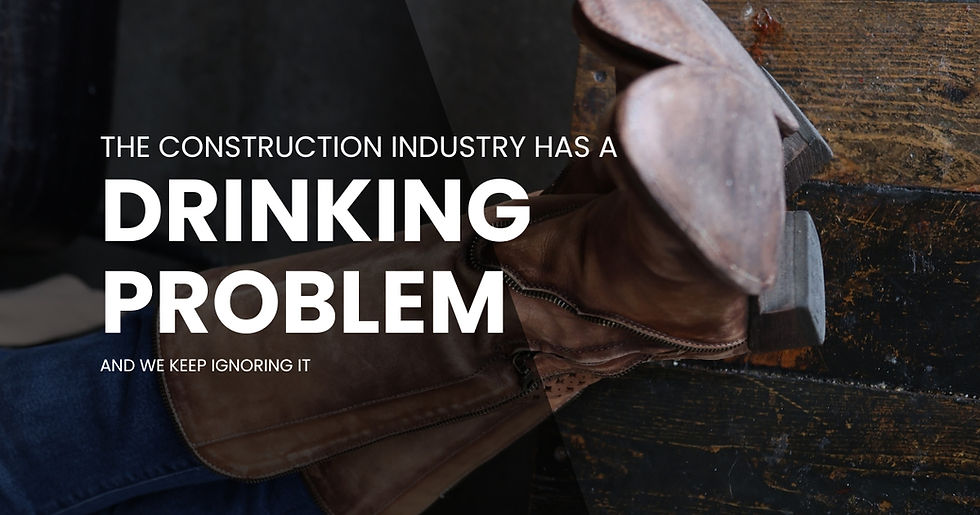
Last month, I wrote about the drinking culture embedded in construction. The unspoken career tax, the inherited defaults, the equity problem nobody wants to name out loud. That conversation broke records. Which told me one thing: you're paying attention. And you're ready for the harder conversations. This one is harder.
Mental Health Is a Jobsite Safety Issue. We Just Don't Treat It That Way.
Construction Safety Week and Mental Health Awareness Month land in the same month every year. I don't think that's a coincidence. I think it's a gap we keep stepping over.
We talk about safety constantly in this industry. PTP's. Toolbox talks. Incident reports. Near-miss documentation. We have protocols for almost every physical hazard on a job site.
And then we go home having never once mentioned the thing that's killing more construction workers than falls.
Construction workers die by suicide at four times the rate of the general population. Not twice. Four times. That number is higher than the fatal fall rate — the hazard we've built entire safety systems around.
We have harnesses.
We have guardrails.
We have mandatory fall protection training.
We have almost nothing for this.
This Isn't a Soft Issue. It's Physics.
Here's the argument I want construction leaders to be able to make in their own organizations — because the "mental health is important" framing isn't landing, and it seems it never will in this industry. So let's try a different one.
Sleep deprivation impairs judgment at the same rate as legal intoxication. We have zero tolerance policies for showing up drunk. We have almost no policy for showing up on four hours of sleep for the third week in a row.
Chronic stress narrows attention and increases risk tolerance. An anxious worker is a distracted worker. A distracted worker on a job site is a safety hazard. Not a feelings problem. A physics problem.
Grief impairs cognitive function. A worker who just lost someone — or who is losing themselves slowly to something they can't name — is making decisions at a fraction of their capacity. And their crew is working under those decisions every day.
These are safety issues. The organizations that figure that out first are going to have fundamentally different incident rates than the ones that don't.
What's Really Happening
Most workers in this industry are not struggling because they're weak or incompetent. They're struggling because the system they're working inside was likely designed to extract maximum output from human beings without accounting for what that costs over time.
The pace. The pressure. The culture that says leave it at the door. The expectation that you show up at 100% regardless of what happened at home last night.
The identity so wrapped up in the work that admitting struggle feels like professional suicide.
Since I started sharing my story, people have been coming to me directly — sharing their struggles and their fears about why they're postponing help. Not strangers. People in this industry. People who've been watching and waiting to see if it was safe to say something out loud. The reasons are always some version of the same calculation.
What will this cost me?
My job.
My reputation.
My next opportunity.
What my partner thinks.
What my team thinks.
What you think.
I asked construction leaders recently when the last time someone checked in on them was. 55% said they're usually the one doing the asking. Nobody's checking in on them.
That's not a workforce data problem. That's a loneliness problem wearing a hard hat.
People are open to help. They know they need help. And they are still waiting. For those who have gotten help, it's taking them months, sometimes years to do so, because the risk of asking felt bigger than the risk of carrying it alone.
Help exists. The risk of asking is almost never as high as the cost of not asking. But you can't convince someone of that from the outside. You can only keep saying it until they're ready to hear it.


What the Data Says About What You're Paying For
Research consistently shows that the vast majority of organizations recognize the importance of mental health — yet fewer than one in five workers say they would discuss it with their supervisor. There's a gap between what organizations think they're offering and what workers feel safe accessing. That gap has a price tag.
One disengaged employee costs an organization an average of $34,000 per year in lost productivity. Replacing a mid-level construction professional runs $75,000 to $150,000 when you account for recruiting, onboarding, and the institutional knowledge that walked out the door. The people leaving aren't leaving because the pay is wrong. They're leaving because the environment is wrong. They're just not going to tell you that in the exit interview.
The silent exits are the most expensive because you can't fix what you don't know is broken.
Four Things Any Leader Can Do This Month
Not a program. Not a budget line. Four things that cost nothing except the willingness to do them differently.
Ask a better question. Not "you good?" on the way to the coffee maker. The real version. "What's been the hardest part of this week for you?" Stop. Wait for the answer. That one shift changes everything about whether people feel safe saying something.
Encourage your supervisors to notice (not diagnose). You don't need a clinical background to notice when someone's energy has shifted. When a reliable person starts showing up inconsistently or when someone who used to engage has gone quiet...Notice. Check in. That's the whole "training".
Name stress as a safety factor in your toolbox talks. Fatigue, grief, and anxiety — these affect reaction time, judgment, and risk tolerance the same way physical impairment does. Acknowledge that out loud in a pre-task plan. Watch what happens.
Model it yourself. One honest sentence from a leader changes everything. You don't have to share your whole story. You just have to let your crew see that you're a human being carrying something and still showing up. That's the permission slip most of them have been waiting for.
The Say Something Guide below walks through exactly how to do all four of these — with specific language, real prompts, and a framework for following up after the first conversation.
The Bigger Picture
The organizations that figure this out first aren't going to win because they're soft. They're going to win because they're paying attention to what their people actually need — and building work environments that people don't have to recover from. That's a competitive advantage, not a wellness initiative. It starts with one leader deciding to ask a better question this month.

Say Something.
I built a free guide for May, the first half for the individual who's been carrying something and hasn't said it out loud yet...
...and the second half for the leader who wants to show up for their crew and doesn't know how to start.
It's practical. It's specific. It's written for the people in this industry who know something needs to change but haven't figured out how to begin.
Leading a team through change?

Book a Discovery Call
Whether you're exploring organizational consulting, individual coaching, or have questions about our approach, we'd like to hear from you.
If you're looking to dive deeper...

Book a Blueprint Session
The Blueprint is a 90-minute working session that finds the system underneath the problem and gets you moving — $297, virtual, open to anyone navigating a pattern they can't break alone.


Comments